Blackjack rules, explained in plain English
Every rule in plain English, from card values to what dealer hits soft 17 means.
The object of the game
Blackjack is played between each player and the dealer. Each round you play a hand against the dealer's hand. A hand that finishes closer to 21 than the dealer's wins, a hand that goes over 21 busts and loses, and equal totals tie. You are not competing with the other players at the table.
Card values, hard hands, and soft hands
Suits do not matter. Each card counts as follows:
- 2 through 10: face value.
- Jack, queen, and king: 10 each.
- Ace: 11, or 1 when 11 would take the hand over 21.
- 2 counts 2
- 3 counts 3
- 4 counts 4
- 5 counts 5
- 6 counts 6
- 7 counts 7
- 8 counts 8
- 9 counts 9
10, jack, queen, and king count 10
An ace counts 1 or 11
Soft and hard totals
A hand with an ace counted as 11 is soft. Ace-7 is a soft 18, and it cannot bust on the next card. A hand with no ace, or with every ace counted as 1, is hard. Ace-7-9 is a hard 17, because counting the ace as 11 would make 27.
The deal and the dealer's check for blackjack
Many games are dealt from a shoe of 4, 6, or 8 shuffled decks. You receive two cards, and the dealer receives two: one face up, called the upcard, and one face down, called the hole card.
In US-style games, when the upcard is an ace or a ten-value card, the dealer checks the hole card for blackjack before anyone acts. This is called the peek. If the dealer has blackjack, it is turned over and the round ends. Every player hand loses except another blackjack, which is a push. If the dealer does not have blackjack, play continues, and you now know it.
In some games, mostly outside the US, the dealer does not check, and the second dealer card arrives only after the players have finished. That rule changes a few strategy plays.
Blackjack, the best hand
An ace and a ten-value card as your first two cards is a blackjack, also called a natural. It is the best hand in the game and beats every other hand, including a 21 made with three or more cards. A natural blackjack scores 3 to 2, so it counts for more than an ordinary win. If the dealer also has blackjack, the hand is a push.
Some tables score a natural at only 6 to 5. That rule does not change any play on the strategy chart, but it is clearly worse for the player, so it is worth checking.
A 21 made after a split is not a blackjack. An ace and a 10 after splitting aces counts as an ordinary 21.
- A♠︎11K♥︎Blackjack
- 7♠︎4♥︎K♣︎Hard 21
Your options on each hand
After the dealer's check, you play your hand. These are the rules for each move under the table rules this site's charts assume:
Hit: take another card. You may keep hitting until you stand or bust.
Stand: end your turn and keep your total.
Double down: take exactly one more card, and the hand counts double. Allowed on any first two cards, including the first two cards of a split hand (double after split), except split aces.
Split: separate a pair into two hands, and each one gets a second card. You can split up to four hands. Split aces get one card each and cannot be split again.
Surrender: give up the hand and lose only half of it. This is late surrender: it comes after the dealer has checked for blackjack, and only as your first decision, before you hit, double down, or split.
After the first decision
After your first hit, you can no longer double down, split, or surrender. From then on you can only hit or stand. A doubled hand takes its one card and then stands automatically.
First two cards
HitStandDouble downSplitpairs onlySurrender
After a hit
HitStand
After double down
One card, then the hand stands
Insurance
When the upcard is an ace, you are offered insurance before the dealer checks. It is a side option that wins only if the dealer has blackjack, and basic strategy declines it every time: on average it costs more than it returns. For it to come out ahead, more than one third of the remaining cards would need to be ten-value. A full shoe has 16 in every 52, a little under one third.
The dealer's rules
The dealer plays by fixed rules and makes no choices. After every player has acted, the dealer turns over the hole card and then:
- hits every total of 16 or less,
- stands on every hard 17 or more,
- on soft 17, hits or stands depending on the table's rule.
- 10♠︎6♥︎16 or lessHit
- 10♠︎7♥︎Hard 17 or moreStand
- A♠︎6♥︎Soft 17H17HitS17Stand
What does dealer hits soft 17 mean?
Soft 17 is any 17 that counts an ace as 11: ace-6, ace-2-4, ace-3-3, or ace-ace-5. Dealer hits soft 17, often written H17, means the dealer must take another card on that hand. Dealer stands on soft 17, written S17 and sometimes printed as "dealer stands on all 17s", means the dealer keeps it.
Hitting soft 17 lets the dealer try to improve a weak total with no risk of busting on that card, so the rule favors the house. With the rules this site assumes and perfect basic strategy, the house edge is roughly 0.5% per hand when the dealer hits soft 17 and 0.3% when the dealer stands.
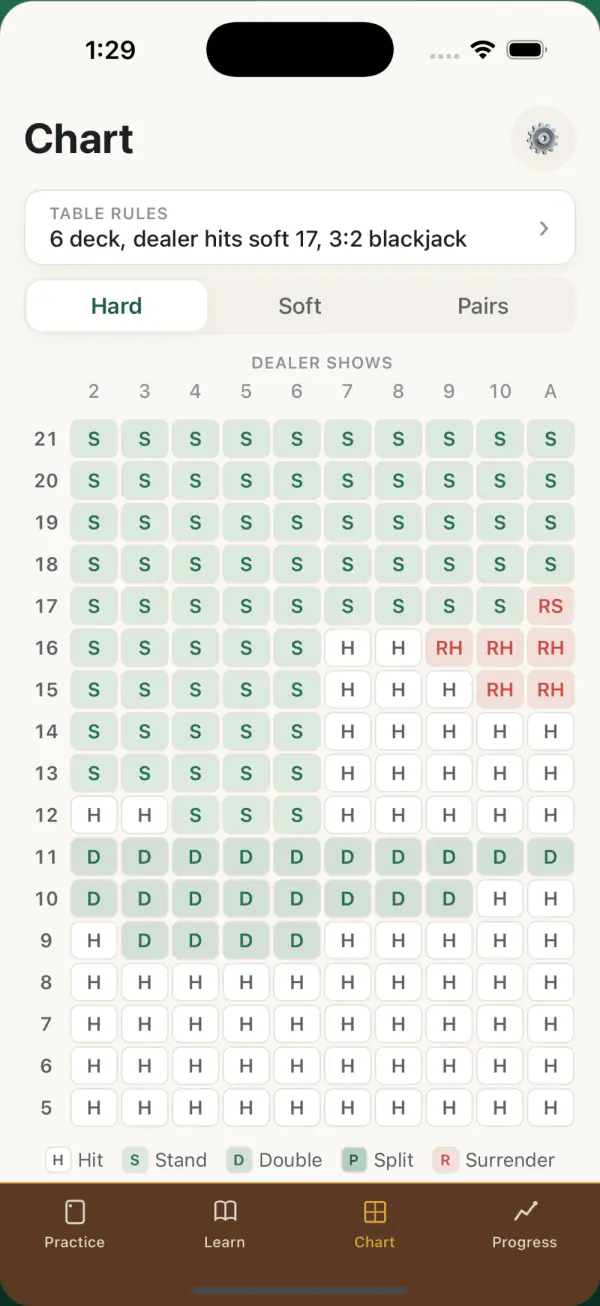
The rule also changes six plays on the basic strategy chart. Each one involves a dealer ace, or a soft 18 or 19 against a weak card:
- Hard 11 vs ace: double down (H17), hit (S17).
- Hard 15 vs ace: surrender, or hit if surrender is not offered (H17); hit (S17).
- Hard 17 vs ace: surrender, or stand if surrender is not offered (H17); stand (S17).
- Soft 18 vs 2: double down, or stand if you cannot (H17); stand (S17).
- Soft 19 vs 6: double down, or stand if you cannot (H17); stand (S17).
- Pair of 8s vs ace: surrender, or split if surrender is not offered (H17); split (S17).
The 6 hands that play differently
H17 Dealer hits soft 17S17 Dealer stands on soft 17
| Hand | Dealer hits soft 17 | Dealer stands on soft 17 |
|---|---|---|
| Hard 11 vs dealer ace | Double downelse hit | Hit |
| Hard 15 vs dealer ace | Surrenderelse hit | Hit |
| Hard 17 vs dealer ace | Surrenderelse stand | Stand |
| Soft 18 vs dealer 2 | Double downelse stand | Stand |
| Soft 19 vs dealer 6 | Double downelse stand | Stand |
| Pair of 8s vs dealer ace | Surrenderelse split | Split |
How each hand is settled
- You bust: you lose, even if the dealer busts afterward.
- The dealer busts: every hand that has not busted wins.
- Neither busts: the higher total wins, and equal totals push.
- Blackjack: beats every other hand and scores 3 to 2. Two blackjacks push.
- Surrender: the hand ends at once and counts as half a loss.
- Double down: the hand is settled like any other, and the result counts double.
Table rules to check before you play
Blackjack rules vary from table to table, and some of them change the best play. Check these:
- The number of decks. The chart is the same for 4, 6, or 8 decks, but one-deck and two-deck games change some plays.
- The soft 17 rule, covered above.
- Whether you can double down after splitting. Some pair splits against a weak dealer card rely on it.
- Whether late surrender is offered.
- Whether the dealer checks for blackjack.
- Whether a natural scores 3 to 2 or 6 to 5. This one does not change the chart.
The rules this site's charts assume
The basic strategy charts on this site assume 4 to 8 decks, a dealer who checks for blackjack, double down on any first two cards, double after split, late surrender, and up to four split hands, with one card on each split ace. There is a chart for each soft 17 rule.
Common questions: Blackjack rules
What does dealer hits soft 17 mean?
It means the dealer must take another card on a 17 that counts an ace as 11, such as ace-6. Where the dealer stands on soft 17, the dealer keeps any 17. Hitting soft 17 adds roughly 0.2 percentage points to the house edge and changes six plays on the basic strategy chart.
Does the dealer have to hit on 16?
Yes. The dealer has no choices: every total of 16 or less is a hit, and every hard 17 or more is a stand. Only soft 17 depends on the table's rule.
Is a 21 after splitting aces a blackjack?
No. An ace and a ten-value card count as blackjack only as your first two cards. After a split, the same two cards are an ordinary 21.
Can you surrender after hitting?
No. Late surrender is only offered as your first decision, after the dealer has checked for blackjack. Once you hit, double down, or split, it is gone.
What happens if you and the dealer both have blackjack?
The hand is a push, a tie that neither side wins.