How to play blackjack: a beginner's guide
Card values, how a round plays out, and the five moves you can make, shown with cards.
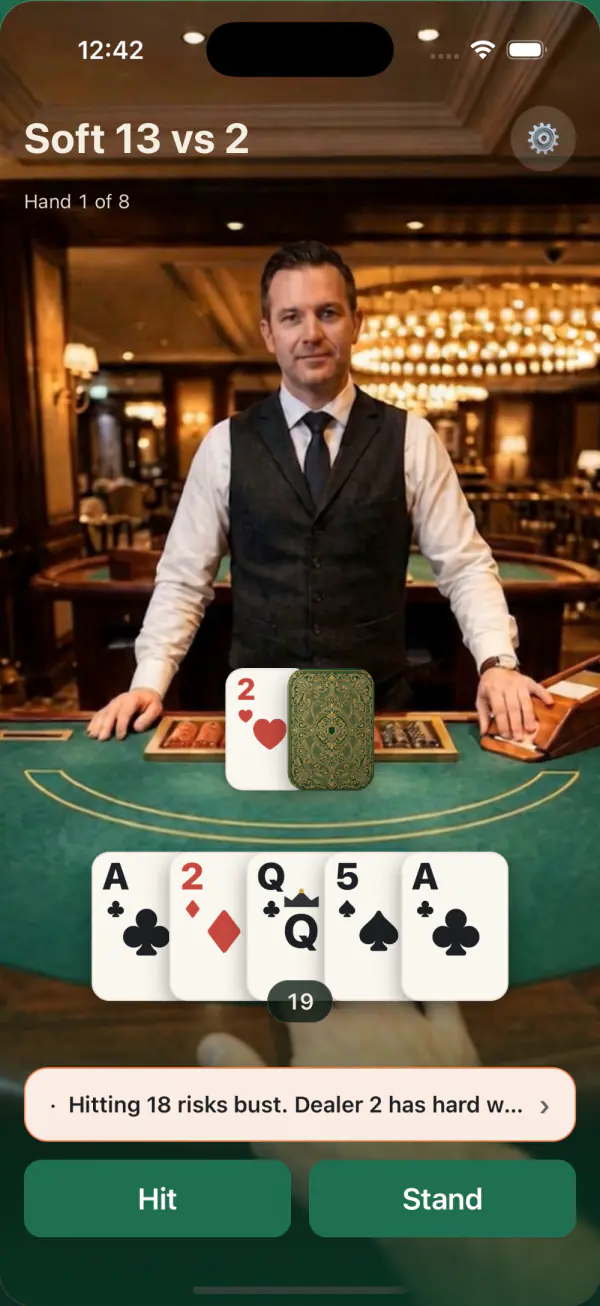
The goal of blackjack
Blackjack is a card game you play against the dealer, not against the other players at the table. Each round you play a hand against the dealer's hand, and the aim is simple: finish with a total closer to 21 than the dealer's, without going over.
Go over 21 and you bust, which loses the hand straight away. If the dealer busts and you have not, your hand wins. If you both finish on the same total, the hand is a tie, called a push.
The best hand of all is a blackjack: an ace plus a ten-value card as your first two cards. It is also called a natural.
Card values
Suits never matter in blackjack. Only the number on the card counts.
- Cards 2 through 10 count at face value.
- Jacks, queens, and kings count as 10. Together with the 10s, these are the ten-value cards.
- An ace counts as 11, or as 1 if 11 would take the hand over 21.
- 2 counts 2
- 3 counts 3
- 4 counts 4
- 5 counts 5
- 6 counts 6
- 7 counts 7
- 8 counts 8
- 9 counts 9
10, jack, queen, and king count 10
An ace counts 1 or 11
Hard hands and soft hands
That flexible ace gives you two kinds of hand. A soft hand has an ace counted as 11, so one more card cannot bust it: ace-6 is a soft 17. A hard hand has no ace, or an ace that has to count as 1: 10-6 is a hard 16, and so is ace-5-10.
The difference matters because a soft hand can take a card with no risk of busting, so basic strategy plays soft hands more boldly than hard ones.
- A♠︎116♥︎Soft 17
- 10♠︎6♥︎Hard 16
- A♠︎15♥︎10♣︎Hard 16
How a round works, step by step
Many games deal from a shoe of 4, 6, or 8 decks, and some use one or two decks. Either way, a round goes like this:
The deal. You get two cards, usually both face up. The dealer gets one card face up, called the upcard, and one face down, called the hole card.
The dealer's check. When the upcard is an ace, the dealer first offers insurance. Then, with an ace or a ten-value card showing, the dealer checks the hole card for blackjack. If it is there, the round ends at once.
Your turn. You play your hand with the choices below, one decision at a time, until you stand or bust.
The dealer's turn. The dealer turns over the hole card and draws by fixed rules, with no choices to make.
The result. Your hand is compared with the dealer's, and the next round begins.
Your choices: hit, stand, double down, split, surrender
On your turn you pick one move at a time. These are the five moves, and when each one is allowed:
Hit: take one more card. You can keep hitting until you stand or bust.
Stand: take no more cards and keep your total.
Double down: take exactly one more card, and the hand counts double. Only allowed on your first two cards.
Split: when your first two cards are a pair, separate them into two hands and play each one on its own. Any two ten-value cards count as a pair of 10s.
Surrender: give up the hand at once and lose only half of it. Only as your first decision, and only where the table offers it.
How the dealer plays
The dealer has no decisions. The dealer must hit any total of 16 or less and stand on 17 or more. The one common variation is soft 17, a 17 that counts an ace as 11, such as ace-6. At some tables the dealer hits soft 17, and at others the dealer stands on it. The rule is usually printed on the table.
Because the dealer's play is fixed, the upcard tells you a lot. A 2 through 6 is a weak card for the dealer: a dealer 6 busts roughly 4 times in 10, while a dealer 10 busts a little under 1 time in 4. That is why the same hand is often played differently against a 6 than against a 10.
- 10♠︎6♥︎16 or lessHit
- 10♠︎7♥︎Hard 17 or moreStand
- A♠︎6♥︎Soft 17H17HitS17Stand
Who wins each hand
- If you bust, you lose, even if the dealer busts later. This is the dealer's built-in advantage: you act first.
- If the dealer busts, every hand that has not busted wins.
- Otherwise the higher total wins, and equal totals are a push.
- A blackjack beats any other hand, including a 21 made with three or more cards, and a natural blackjack scores 3 to 2. If you and the dealer both have blackjack, it is a push.
- If the dealer has blackjack, every hand without one loses. With the dealer's check, you find out before you act, so you never double down or split into a dealer blackjack.
Blackjack for beginners: rules of thumb
Every hand has one best play, decided by your hand and the dealer's upcard. The full answer is called basic strategy and fits on a single chart, but a handful of rules covers most of what you will see:
- Always split aces. Never split 10s or 5s.
- Split 8s against a dealer 2 through 10.
- Stand on hard 13 through 16 against a dealer 2 through 6. Against a 7 or higher, hit them, unless the chart says surrender.
- Hard 12 is the odd one: stand against a 4, 5, or 6, and hit against everything else.
- Double down on hard 11 against a dealer 2 through 10, and on hard 10 against a 2 through 9.
- Never stand on soft 17 or less.
- Always stand on hard 18 or more.
- Decline insurance: on average it costs more than it returns.
- A♠︎A♥︎Pair of acesvs any dealer cardSplit
- K♠︎Q♥︎Pair of 10svs any dealer cardStand
- 5♠︎5♥︎Pair of 5svs any dealer cardHitorDouble down
- 8♠︎8♥︎Pair of 8svs dealer 2 to 10Split
- 10♠︎6♥︎Hard 13 to 16vs dealer 2 to 6Stand
- 10♠︎2♥︎Hard 12vs dealer 4 to 6Stand
- 6♠︎5♥︎Hard 11vs dealer 2 to 10Double down
- 6♠︎4♥︎Hard 10vs dealer 2 to 9Double down
- A♠︎6♥︎Soft 13 to 17vs any dealer cardHitorDouble down
- 10♠︎8♥︎Hard 18 or morevs any dealer cardStand
- A♠︎InsuranceWhen the dealer shows an aceDecline
Hands that trip up beginners
A few hands feel wrong even once you know the rules. Hard 16 against a dealer 10 is a surrender where the table offers it, and a hit where it does not. Hard 12 against a dealer 3 is a hit, not a stand. Soft 18 against a dealer 9 is a hit too, because a dealer 9 finishes on 19 or better often enough to leave 18 behind.
For the full picture, use the chart that matches your table's soft 17 rule. Only six hands change between the two charts.
Hard 12 to 16 vs each dealer card H17
| Hand | Dealer 2 | Dealer 3 | Dealer 4 | Dealer 5 | Dealer 6 | Dealer 7 | Dealer 8 | Dealer 9 | Dealer 10 | Dealer A |
|---|---|---|---|---|---|---|---|---|---|---|
| Hard 16 | S | S | S | S | S | H | H | Rh | Rh | Rh |
| Hard 15 | S | S | S | S | S | H | H | H | Rh | Rh |
| Hard 14 | S | S | S | S | S | H | H | H | H | H |
| Hard 13 | S | S | S | S | S | H | H | H | H | H |
| Hard 12 | H | H | S | S | S | H | H | H | H | H |
- HHit
- SStand
- RhSurrender, or hit if surrender is not offered
Cells with a dark outline play differently when the dealer stands on soft 17.
Common beginner mistakes
- Copying the dealer. Hitting every hand until it reaches 17 ignores the upcard, and every time you bust, you lose before the dealer even plays.
- Being afraid to bust. Standing on 12 through 16 against a dealer 7 or higher leaves you behind too often. Those hands need a hit, or a surrender where the chart calls for one.
- Taking insurance. It feels like protection, but fewer than one third of the cards in a shoe are ten-value, so it comes out behind over time.
- Splitting 10s. A pair of 10s is already a 20. Stand.
- Judging a play by one result. A correct play can still lose a hand. Basic strategy is about the best average result over many hands.
How to practice
The fastest way to learn is to play many hands and find out right away when a decision differs from the chart. Start with the rules of thumb above, then learn the hard totals, then the soft totals, then the pairs. When a hand puzzles you, look it up on its own strategy page, where the reason is written out.
Common questions: How to play blackjack
What is the goal in blackjack?
To finish each hand with a total closer to 21 than the dealer's, without going over. You play only against the dealer, so you are not competing with the other players at the table.
What does an ace count as in blackjack?
An ace counts as 11 unless that would take the hand over 21, and then it counts as 1. A hand with an ace counted as 11 is a soft hand.
What is a push in blackjack?
A push is a tie: you and the dealer finish on the same total. Neither side wins the hand.
When should I double down?
Double down means taking exactly one more card, and the hand counts double. Basic strategy doubles down on hard 11 against a dealer 2 through 10, on hard 10 against a 2 through 9, on hard 9 against a 3 through 6, and on some soft hands, mostly against a dealer 3 through 6.
Should I take insurance?
No. Basic strategy always declines insurance: on average it costs more than it returns. It only wins when the dealer has blackjack, and fewer than one third of the cards are ten-value.
Does basic strategy guarantee a win?
No. It picks the play with the best average result, but any single hand can go either way, and the house keeps a small edge. This site and the Blackjack Trainer app are for practice only.